
Why Fermentation at Home Is Naturally Safe
Fermenting food at home may seem risky, but it is one of the safest preservation methods humans have ever used. This article explains the simple science behind fermentation, showing how salt, beneficial bacteria, and natural acidification work together to protect food and make it safe, stable, and nourishing.
INFO
5/11/2026
Why Fermentation at Home Is Naturally Safe
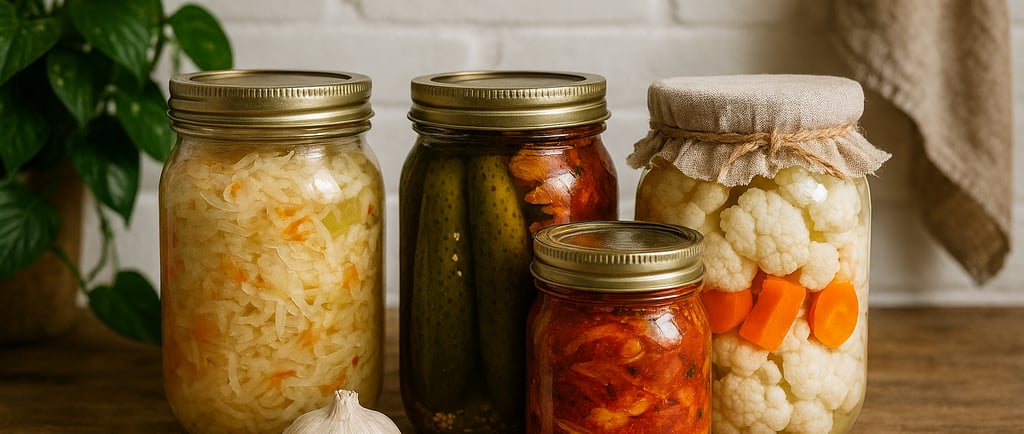
Fermenting food at home can feel counter‑intuitive at first. We are taught that food left out spoils, yet fermentation deliberately leaves food at room temperature for days or even weeks. In reality, traditional fermentation is one of the oldest and safest food‑preservation methods humans have ever used, and its safety is grounded in well‑understood biology and food science rather than luck or folklore.
The Science That Makes Fermentation Safe
Home fermentation—especially vegetable lacto‑fermentation—relies on lactic acid bacteria (LAB) that naturally live on fresh produce. When vegetables are salted and kept submerged under brine, these beneficial bacteria consume natural sugars and convert them into lactic acid.
As lactic acid builds up, the food becomes increasingly acidic. This rapid drop in pH is the core safety mechanism of fermentation. Within the first few days, a healthy ferment typically reaches a pH below 4.6, which is the critical threshold below which dangerous pathogens such as Clostridium botulinum, Salmonella, and E. coli cannot survive or produce toxins.
In other words, fermentation does not rely on stopping microbial activity—it relies on directing it. You intentionally create conditions where helpful microbes thrive and harmful ones are excluded.
Why Fermented Foods Are Often Safer Than Fresh Foods
It may sound surprising, but properly fermented food can be microbiologically safer than raw food. Fresh vegetables exist at a neutral pH where many kinds of bacteria can grow. Fermented vegetables exist in a highly acidic, salty environment that actively suppresses pathogens.
Food safety researchers have consistently found that common foodborne pathogens die off quickly as acid levels rise during fermentation. This is why fermented vegetables have been safely consumed across cultures for thousands of years—long before refrigeration, modern sanitation, or microbiology existed.
The Protective Role of Salt
Salt plays a crucial supporting role in fermentation safety. At typical fermentation levels (around 2–5%), salt:
Inhibits spoilage organisms and harmful bacteria
Gives lactic acid bacteria a competitive advantage
Draws water and sugars out of vegetables to feed beneficial microbes
This creates a protective window at the very start of fermentation, before acidity becomes high enough to provide full protection. By the time salt‑tolerant pathogens could theoretically grow, the pH has already fallen to a safe level.
Addressing the Common Fear of Botulism
Botulism is often cited as a reason to avoid home fermentation, but this concern is frequently misunderstood. Botulism is associated with low‑acid, oxygen‑free environments, such as improperly canned vegetables held above pH 4.6. Proper lacto‑fermentation avoids these conditions entirely by design.
When vegetable ferments are correctly salted and allowed to acidify naturally, they do not support botulinum toxin production. For this reason, food safety authorities distinguish clearly between fermentation and low‑acid canning, which carry very different risks and safety requirements.
If in doubt, you can also purchase easy to use Ph strips (available on Amazon) to check you ferment’s Ph.
Built on Millennia of Human Experience
Fermentation is not a modern experiment. Humans have relied on fermented foods for at least 9,000 years across every inhabited continent. Cheese, sauerkraut, kimchi, pickles, yogurt, sourdough, kefir, and countless regional ferments all developed independently because they worked—preserving food safely while improving flavour, digestibility, and shelf‑life.
Modern science has simply explained what traditional cultures already knew: fermentation works because it creates conditions that protect food rather than endanger it.
What Makes Home Fermentation Safe in Practice
While fermentation is naturally safe, successful results depend on following a few core principles recognised by food‑safety authorities:
Clean equipment and good hygiene
Adequate salt levels
Keeping food submerged under brine
Allowing enough time for acid to form
Storing finished ferments in cool conditions
When these simple rules are followed, home fermentation is considered a safe and reliable method of food preparation and preservation.
Confidence Through Understanding
Fermentation can look mysterious, but it is governed by predictable biological processes. Once you understand that fermentation works by lowering pH, suppressing pathogens, and promoting beneficial bacteria, fear is replaced with confidence.
What appears at first glance to be risky is, in fact, one of the most elegant food‑safety systems nature has ever produced – and beneficial for your gut.
Fermenting at home is not only safe—it is a practice deeply rooted in human history, supported by modern science, and trusted by food‑safety experts worldwide.